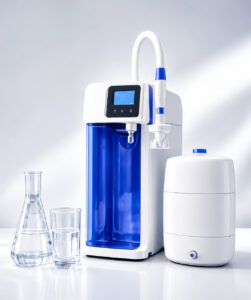
Laboratory water systems must deliver consistent water quality over long periods of use. However, water quality can be affected by feed water condition, consumable life, storage tank design, distribution loop condition, microbial growth, atmospheric contamination, operating practices and maintenance frequency.
This section helps laboratories understand common water quality problems, their possible causes and practical steps that can help maintain reliable purified and ultrapure water system performance.
ICP-OES is widely used for multi-element analysis in pharmaceutical, environmental, chemical, food, mining and industrial laboratories.
The technique measures light emitted by excited atoms and ions in a plasma. Water used for standards, blanks and sample preparation should therefore contribute minimal ionic and metallic contamination.
Poor Water Quality May Cause
Recommended Water Quality
Freshly dispensed Type I ultrapure water is generally recommended for:
The required water quality depends on the elements being analysed and the required detection limits.
Best Practices
Use freshly dispensed water and clean containers suitable for elemental analysis. Avoid storing ultrapure water for long periods, as it may absorb contaminants from the atmosphere or storage vessel.
Water quality should be checked together with the purity of acids, reagents, standards, tubing and laboratory ware. High contamination in a blank may originate from any part of the preparation procedure.
Explore Water Solutions for ICP-OES
Water is not the only cause of chromatography problems, but it should be checked early because it is used in mobile phases, blanks, dilution, rinsing and sample preparation.
ICP-MS is one of the most sensitive techniques used for elemental and isotopic analysis. It is capable of detecting many elements at very low concentrations.
Because of this sensitivity, even trace quantities of metals, ions or organic contaminants in water may affect analytical results.
Poor Water Quality May Cause
Recommended Water Quality
Freshly dispensed Type I ultrapure water with very low ionic and trace-metal contamination is recommended for:
Low and consistent background contamination is particularly important when measuring elements at parts-per-billion or parts-per-trillion levels.
Best Practices
Use water immediately after dispensing and collect it in containers suitable for trace-element analysis.
Avoid unnecessary contact with metallic fittings, unsuitable tubing or general-purpose laboratory containers after the final purification stage.
Water resistivity is an important indicator of ionic purity, but a high resistivity value alone does not confirm the absence of every trace metal. Analytical blanks should therefore be used to verify suitability for the required method.
The quality of acids, standards, containers, gloves, laboratory air and sample-preparation procedures should be controlled along with the water.
Explore Water Solutions for ICP-MS
Trace-element methods are highly sensitive to ionic and metallic contamination. Water, containers, reagents and laboratory handling must all be controlled.
Atomic Absorption Spectroscopy is used for quantitative determination of metals in pharmaceutical, environmental, food, chemical, clinical and industrial samples.
Water is used extensively during calibration, dilution, blank preparation and laboratory-ware rinsing. Contaminated water may contribute directly to the measured concentration of the target element.
Poor Water Quality May Cause
Recommended Water Quality
Freshly dispensed Type I ultrapure water is generally recommended for:
For routine measurements at higher concentrations, the laboratory should still ensure that water contamination remains insignificant compared with the analytical concentration.
Best Practices
Use clean containers and laboratory ware that do not release the elements being analysed.
Prepare blanks and standards using water from the same verified source. Flush the dispensing outlet before collecting water after long periods of non-use.
If blank contamination is detected, separately investigate:
Water-quality parameter | Importance in elemental analysis |
Resistivity and conductivity | Indicate the overall level of ionic contamination |
Trace-metal contamination | May directly increase blanks or create false-positive results |
TOC | May contribute to contamination or affect sensitive analytical procedures |
Particles | May contaminate samples or affect sample-introduction components |
Microbial contamination | Can produce particles, organics and variable water quality |
Consistency | Supports reliable standards, blanks and reproducible results |
Contamination in spectroscopy does not always originate from the water purification system. The complete analytical preparation process should be reviewed.
Common contamination sources include:
A systematic blank study can help identify whether the contamination originates from water, reagents, containers or the complete analytical method.
Use Freshly Dispensed Water
Ultrapure water should preferably be collected close to the time of use. Long storage may allow absorption of carbon dioxide, airborne contaminants or substances released from the container.
Use Suitable Containers
Containers should be selected according to the analytical method and elements being measured. General-purpose glassware or previously used containers may not be suitable for trace analysis.
Flush Stagnant Outlets
After a long idle period, flush the point-of-use line before collecting water for blanks, standards or critical samples.
Monitor Water Quality
Monitor resistivity, conductivity and system alarms. TOC and microbial quality may also be relevant depending on the application.
Maintain the Complete Purification Path
Good final water quality depends on:
Replace Consumables at the Correct Time
Delayed replacement of pretreatment filters, polishing cartridges, UV lamps, final filters or tank vent filters may affect water quality and shorten the life of downstream components.
The appropriate system should be selected based on:
ICP-MS laboratories generally require the most stringent control of trace-metal and ionic contamination. ICP-OES and AAS requirements depend on the elements, concentration range and sensitivity of the analytical method.
For laboratories operating several instruments, a centralized water system may provide purified and ultrapure water through a common generation, storage and distribution arrangement.
Share the following details with TKA:
TKA can help evaluate the appropriate purification technology, production capacity, polishing configuration, storage system and dispensing arrangement for your laboratory.
TKA Ultrapure Water Technologies India Pvt. Ltd.
Unit 311, Globe Business Park,
Kalyan – Badlapur Road, Laxmi Nagar, Ambarnath (W) 421501
Thane, Maharashtra, India
Phone: +91-9987174888 / +91-9867964888
Email: info@tkaindia.com
© 2026 TKA India | All Rights Reserved.
TKA Ultrapure Water Technologies India Pvt. Ltd. is an Indian company focused on the design, manufacture and support of laboratory water purification systems… Read More