Ultrapure water has extremely low ionic content and very low buffering capacity. Because of this, pH measurement in Type I and high-purity Type II water is difficult, unstable and often misleading.
When ultrapure water is exposed to air, it quickly absorbs carbon dioxide. This forms weak carbonic acid and can shift the measured pH below 7, even though the water quality may still be suitable. In addition, because ultrapure water contains very few ions, a normal pH electrode may not give a stable or reliable reading.
For high-purity water, resistivity, conductivity and TOC are more meaningful quality indicators than direct pH measurement. Pharmacopeial water testing also recognizes this issue. USP guidance for Water Conductivity <645> uses conductivity-based testing for Purified Water and Water for Injection; pH measurement is only part of the later conductivity test stage after increasing ionic strength with potassium chloride to make the pH reading valid. USP explains that without increasing ionic strength, pH measurement can be highly unstable and inaccurate.
Therefore, Type I and high-purity Type II water should not be judged by ordinary pH measurement alone. If water quality is in doubt, check resistivity, conductivity, TOC, microbial condition, consumable status and system maintenance history.
USP <645> recognizes that direct pH measurement of very low-conductivity water can be unstable and inaccurate unless ionic strength is increased. In Stage 3 of the USP water conductivity test, potassium chloride is added before measuring pH to increase ionic strength and allow a more reliable pH measurement. Therefore, ordinary pH measurement of Type I or high-purity Type II water should not be used alone to judge water quality. Resistivity, conductivity, TOC and microbial parameters are more meaningful indicators for high-purity laboratory water.
Reference: USP <645> Water Conductivity guidance explains that pH measurement of very low-conductivity water is unstable unless ionic strength is increased.
Stored purified water can be affected by the surrounding laboratory atmosphere. Whenever water is drawn from a storage tank, air enters the tank to replace the volume of water removed. A tank vent filter is used to protect the stored water by filtering this incoming air.
However, laboratory air is not always clean. In analytical, pharmaceutical and chemical laboratories, the atmosphere may contain carbon dioxide, volatile organic compounds, solvent vapours, peroxide traces, particles and microorganisms depending on the nature of work being carried out in the laboratory.
Carbon dioxide from air can dissolve into purified water and reduce resistivity by forming weak ionic species. Volatile organic compounds and solvent vapours may contribute to organic contamination and increase TOC. Airborne particles and microorganisms can also compromise stored water quality if not properly controlled.
A good tank vent filter helps reduce the entry of airborne contaminants, particles and microorganisms into the storage tank. Some vent filters also use adsorbent media such as activated carbon to reduce organic vapours and carbon dioxide exposure. However, the protection capacity of a vent filter is finite. Its life depends on the quality of laboratory air, tank usage, volume of air entering the tank, humidity, chemical vapour load and operating environment.
For this reason, tank vent filters should be replaced periodically as part of preventive maintenance. A blocked, exhausted or overdue vent filter may no longer provide adequate protection and can allow atmospheric contamination to affect stored water quality.
Regular replacement of tank vent filters helps protect purified water during storage, maintain resistivity and TOC stability, reduce microbial contamination risk and improve long-term system reliability.
To help protect stored purified water from atmospheric contamination, TKA offers tank vent filter solutions designed for laboratory water storage tanks.
Learn more about TKA Tank Vent Filters (link to take to tank vent filter page)
Even when a storage tank is fitted with a vent filter, the surrounding laboratory atmosphere can influence stored purified water. Whenever water is drawn from the tank, air enters the tank to replace the withdrawn water volume. If the laboratory atmosphere contains carbon dioxide, volatile organic compounds, solvent vapours, peroxide traces, particles or microorganisms, these contaminants can challenge the tank vent filter.
If the vent filter is exhausted, blocked, incorrectly installed or not replaced periodically, atmospheric contaminants may enter the storage tank and affect the stored water quality.
Carbon dioxide can dissolve into stored purified water and form weak ionic species. This increases ionic load and can reduce resistivity. Organic vapours and solvent traces may increase TOC. Airborne microorganisms and particles can increase microbial and particulate contamination risk.
This stored tank water is often used as feed water for the downstream Type I ultrapure polishing system. If the tank water quality deteriorates, the Type I system has to work harder to remove the additional contamination.
This can lead to:
Therefore, protecting stored purified water is important even when a downstream Type I system is installed. The better the tank water quality, the more stable and economical the Type I polishing stage becomes.
Tank vent filters have finite protection capacity. Their life depends on tank usage, laboratory air quality, humidity, solvent vapour load, CO₂ exposure and the amount of air entering the tank. Periodic replacement of the vent filter should be part of preventive maintenance to protect stored water quality and downstream ultrapure water performance.
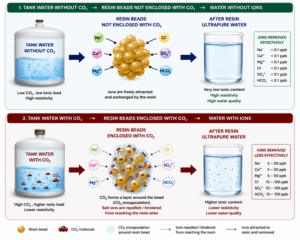
Fig.1 Effect of CO₂ on Type I polishing resin: CO₂ absorbed from air forms weak ionic species in water. These ions increase the load on polishing resin, reduce available exchange capacity, and can lead to faster cartridge exhaustion and unstable resistivity.
The Type I system should polish good-quality feed water; it should not be forced to correct avoidable contamination introduced during storage.

TKA Ultrapure Water Technologies India Pvt. Ltd.
Unit 311, Globe Business Park,
Kalyan – Badlapur Road, Laxmi Nagar, Ambarnath (W) 421501
Thane, Maharashtra, India
Phone: +91-9987174888 / +91-9867964888
Email: info@tkaindia.com
© 2026 TKA India | All Rights Reserved.
TKA Ultrapure Water Technologies India Pvt. Ltd. is an Indian company focused on the design, manufacture and support of laboratory water purification systems… Read More