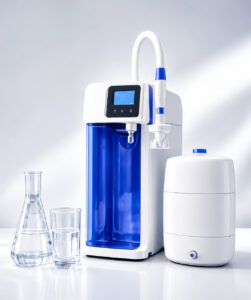
Laboratory water systems must deliver consistent water quality over long periods of use. However, water quality can be affected by feed water condition, consumable life, storage tank design, distribution loop condition, microbial growth, atmospheric contamination, operating practices and maintenance frequency.
This section helps laboratories understand common water quality problems, their possible causes and practical steps that can help maintain reliable purified and ultrapure water system performance.
Water is used throughout life-science laboratories for media preparation, buffers, reagents, standards, washing, molecular assays, instrument operation and general laboratory procedures.
Contaminants in water may affect cell growth, enzyme activity, nucleic-acid reactions, protein analysis and experimental reproducibility. Ionic impurities, organics, microorganisms, endotoxins, nucleases and particles may influence different applications in different ways.
The appropriate water quality therefore depends not only on resistivity, but also on the biological sensitivity of the application and the way the water is collected, stored and handled.
Water for Consistent Cell Growth and Experimental Reproducibility
Cell culture applications require carefully controlled media, buffers and reagents. Water used in their preparation can influence cell viability, morphology, proliferation and response to experimental conditions.
Poor Water Quality May Cause
Recommended Water Quality
High-quality purified or Type I ultrapure water may be used for preparing:
The final water requirement depends on the cell line, culture method and sensitivity of the experiment.
For sensitive mammalian-cell applications, additional control of microorganisms and endotoxins may be required.
Important Consideration
A high resistivity value does not automatically confirm that water is sterile, endotoxin-free or suitable for every cell-culture application.
Where required, laboratories should use an appropriate final filtration, sterilization or validated endotoxin-control procedure after water purification.
Best Practices
Explore Water Solutions for Cell Culture
High-Quality Water for Tissue Growth and Maintenance
Tissue culture includes the maintenance and growth of animal tissues, plant tissues, organoids and other biological materials under controlled laboratory conditions.
The preparation of culture media, growth regulators, buffers and washing solutions requires water of consistent quality.
Poor Water Quality May Cause
Recommended Water Quality
Purified or Type I ultrapure water, selected according to application sensitivity, may be used for:
For sterile tissue-culture procedures, the prepared medium or solution should be sterilized using the appropriate validated method.
Best Practices
Explore Water Solutions for Tissue Culture
Ultrapure Water for Sensitive Molecular Reactions
Molecular-biology techniques depend on enzymes, nucleic acids and carefully controlled reaction conditions. Even small quantities of ionic contaminants, organics, nucleases or microbial residues may affect reaction performance.
Water is commonly used for:
Poor Water Quality May Cause
Recommended Water Quality
Type I ultrapure water is generally suitable as the starting water for many molecular-biology reagents and buffers.
However, applications involving DNA or RNA may also require water that is specifically:
Important Consideration
Type I water is not automatically guaranteed to be RNase-free, DNase-free or sterile merely because it has high resistivity.
For highly sensitive nucleic-acid work, the laboratory should use a validated treatment, final filtration or certified nuclease-free preparation method.
Best Practices
Explore Water Solutions for Molecular Biology
Ultrapure Water for DNA and RNA Workflows
Genomics applications include DNA extraction, RNA isolation, PCR, qPCR, sequencing-library preparation, genotyping, hybridization and next-generation sequencing workflows.
These procedures are sensitive to contamination because they often involve small sample quantities, low nucleic-acid concentrations and enzyme-dependent reactions.
Poor Water Quality May Cause
Recommended Water Quality
Freshly dispensed Type I ultrapure water may be used as the base water for:
For direct use in sensitive DNA or RNA reactions, the water should meet the laboratory’s nuclease-free and contamination-control requirements.
Best Practices
Water Quality Is Only One Part of Genomics Control
Contamination may also originate from:
The complete workflow should therefore be reviewed when unexpected amplification or sequencing contamination occurs.
Explore Water Solutions for Genomics
Ultrapure Water for Protein Analysis and Mass Spectrometry
Proteomics involves the extraction, separation, identification and quantification of proteins and peptides. Water quality can influence sample preparation, enzymatic digestion, electrophoresis, chromatography and mass-spectrometric analysis.
Poor Water Quality May Cause
Recommended Water Quality
Freshly dispensed Type I ultrapure water with low TOC and low ionic contamination is generally recommended for:
Potential Contamination Sources
Proteomics workflows are highly sensitive to contaminants from:
Best Practices
Water-quality parameter | Importance in life-science laboratories |
Resistivity and conductivity | Indicate ionic contamination that may affect buffers and enzyme reactions |
TOC | Organic contamination may affect cells, proteins and sensitive analytical methods |
Microorganisms | May contaminate media, cultures, reagents and laboratory procedures |
Endotoxins | May affect sensitive mammalian cells and biological-response studies |
Nucleases | May degrade DNA or RNA |
Particles | May contaminate cultures, reagents and analytical instruments |
Consistency | Supports reproducibility across experiments and reagent batches |
Understanding Water-Quality Terminology
Ultrapure Water
Ultrapure water generally refers to water with very low ionic, organic and particulate contamination. It is commonly used for sensitive laboratory applications.
Sterile Water
Sterile water has undergone a process intended to remove or inactivate viable microorganisms. High resistivity alone does not establish sterility.
Endotoxin-Controlled Water
This water is prepared and handled to meet a specified endotoxin requirement. It may be required for sensitive cell-based applications.
Nuclease-Free Water
Nuclease-free water is prepared or validated to prevent DNase or RNase activity. It is particularly important for DNA and RNA work.
These terms describe different characteristics. Water may meet one requirement without automatically meeting all the others.
Use Freshly Dispensed Water
Purified and ultrapure water may absorb carbon dioxide, microorganisms, particles and airborne organics after dispensing. Use it as close as practical to the time of preparation.
Use Suitable Containers
Containers should be clean, compatible with the application and protected from contamination. General-purpose containers may not be suitable for genomics, cell culture or proteomics.
Control the Point of Use
Keep the dispensing outlet clean and flush stagnant water after prolonged non-use. Avoid direct contact between the nozzle and the collection container.
Maintain Microbial Control
Storage tanks, vent filters, distribution loops and final filters should be maintained and sanitized according to the system design and laboratory requirements.
Select the Correct Final Treatment
Depending on the application, the final treatment may include:
Monitor More Than Resistivity
High resistivity confirms low total ionic contamination, but it does not independently verify microbial, endotoxin, nuclease or TOC quality.

The appropriate system should be selected according to:
A laboratory performing several life-science applications may require both Type II purified water for general laboratory use and Type I ultrapure water for critical reagent and analytical preparation.
Share the following details with TKA:
TKA can help evaluate the appropriate purification, polishing, final-filtration, storage and dispensing configuration for your laboratory.
TKA Ultrapure Water Technologies India Pvt. Ltd.
Unit 311, Globe Business Park,
Kalyan – Badlapur Road, Laxmi Nagar, Ambarnath (W) 421501
Thane, Maharashtra, India
Phone: +91-9987174888 / +91-9867964888
Email: info@tkaindia.com
© 2026 TKA India | All Rights Reserved.
TKA Ultrapure Water Technologies India Pvt. Ltd. is an Indian company focused on the design, manufacture and support of laboratory water purification systems… Read More