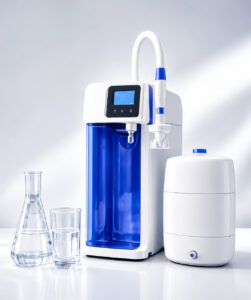
Water is one of the most frequently used laboratory reagents. It is required for preparing chemicals, buffers and standards, washing laboratory ware, supplying instruments and supporting routine experimental procedures.
Although general laboratory applications may not always require Type I ultrapure water, inconsistent or unsuitable water quality can affect reagent concentration, pH, appearance, stability, analytical results and equipment performance.
The appropriate water grade should therefore be selected according to the application rather than using the same water quality for every purpose.
Consistent Water Quality for Reliable Reagents and Solutions
Water forms a major part of many laboratory reagents and working solutions. Ionic impurities, organic contamination, microorganisms or particles present in the water may react with reagent components or affect their stability.
Common Uses
Poor Water Quality May Cause
Recommended Water Quality
The appropriate water grade depends on the sensitivity of the reagent and its intended use.
Laboratories may use:
Reagents used in HPLC, ICP, molecular biology or other highly sensitive techniques may require application-specific Type I water.
Best Practices
Investigate water quality when precipitation, colour change or poor analytical performance occurs.
Purified Water for Stable pH and Ionic Composition
Buffers are used to maintain a controlled pH during chemical, biological and analytical procedures. Water quality can influence the final pH, conductivity, ionic strength and stability of a buffer.
Small amounts of ionic contamination may be significant when preparing low-concentration buffers or buffers used in sensitive analytical and biological applications.
Common Uses
Poor Water Quality May Cause
Recommended Water Quality
Type II purified water is suitable for many routine buffer-preparation applications.
Type I ultrapure water may be required for:
Best Practices
Purified Water for Clean, Residue-Free Laboratory Ware
Glassware and reusable laboratory vessels may retain detergents, salts, particles and contaminants after washing. These residues can later enter samples, reagents or analytical procedures.
A properly designed washing and rinsing process helps reduce carryover and supports reliable laboratory results.
Common Applications
Poor-Quality Rinse Water May Cause
Recommended Water Quality
Different stages of washing may use different water qualities:
Using Type I water for every washing stage is normally unnecessary and may increase operating cost without providing additional benefit.
Best Practices
Separate general washing from glassware used for trace or molecular analysis.
Stable Water Supply for Reliable Instrument Operation
Many laboratory instruments require purified water for operation, rinsing, cooling, humidification, steam generation or reagent preparation.
The required water quality, pressure and flow differ between instruments. Water-system selection should therefore be based on the manufacturer’s specification for each connected device.
Common Instruments Requiring Water
Poor Feed-Water Quality May Cause
Water-Supply Factors to Consider
The instrument may specify requirements for:
Recommended Water Quality
Depending on the instrument, the required feed may be:
The instrument manufacturer’s latest water specification should be checked before connecting the system.
Best Practices
Review water quality when recurring instrument problems develop.

Purified Water for Routine Laboratory Activities
General laboratory work includes many procedures that do not fall within a single specialised analytical category. These activities still benefit from consistent and appropriately selected water quality.
Common Uses
Poor Water Quality May Cause
Recommended Water Quality
For many laboratories, a combination of water grades is more practical than using one grade for every purpose.
A typical arrangement may include:
Best Practices
Application | Typical Starting Water Grade |
Initial glassware washing | Tap, softened or RO water, depending on feed quality |
Final glassware rinsing | RO, Type III or Type II water |
Routine reagent preparation | Type II purified water |
Routine buffer preparation | Type II purified water |
Sensitive standards and analytical blanks | Type I ultrapure water |
HPLC, ICP-MS or molecular applications | Application-specific Type I water |
General instrument feed | As specified by the instrument manufacturer |
Autoclave or steam-generator feed | Pretreated or RO water as specified |
General laboratory washing | RO or Type III water |
Trace-analysis vessel rinsing | Type I ultrapure water where required |
This table provides general guidance. The actual water requirement should be determined from the method, equipment specification and laboratory quality procedure.
Using only one water grade throughout the laboratory may not be technically or economically appropriate.
Type I water provides very high purity but is generally produced in smaller quantities using final polishing consumables. Using it for routine washing can shorten cartridge life and increase operating cost.
Conversely, RO or Type III water may be suitable for washing and equipment feed but may not provide the purity required for standards, sensitive reagents or trace analysis.
A well-designed system may therefore provide:
This approach helps balance water quality, availability and operating cost.
Water-quality parameter | Potential importance |
Conductivity and resistivity | Indicate ionic contamination |
Hardness | May cause scale and deposits |
Chlorine | May damage membranes or affect sensitive procedures |
Silica | May deposit in heated equipment and affect some analyses |
TOC | May affect sensitive reagents and analytical methods |
Microorganisms | May contaminate stored solutions and biological procedures |
Particles | May contaminate samples or block instrument tubing |
Pressure and flow | Important for directly connected instruments |
Consistency | Supports reproducible laboratory procedures |
Water-related problems may originate from:
When a problem occurs, the complete water path and laboratory procedure should be reviewed.
Match Water Quality to the Application
Use the correct grade for each activity. Higher purity is not always necessary, but insufficient purity may affect the result.
Protect Stored Water
Use closed storage tanks, suitable vent filters, circulation and periodic sanitization.
Use Fresh Water for Critical Work
Freshly dispensed water reduces the risk of contamination from storage containers and atmospheric exposure.
Maintain Instruments and Distribution Lines
Long tubing, unused outlets and stagnant branches can reduce water quality at the point of use.
Monitor Water Consumption
Consumption records help identify changing demand, leakage, misuse and the need for future system expansion.
Maintain Preventive Maintenance Records
Document:
Alarms and service work
The system should be selected according to:
A laboratory with diverse requirements may benefit from an integrated system capable of producing Type II and Type I water while also supplying RO or Type III water for general applications.
Share the following details with TKA:
TKA can help evaluate the appropriate pretreatment, purification, storage, polishing and dispensing configuration for your laboratory.
TKA Ultrapure Water Technologies India Pvt. Ltd.
Unit 311, Globe Business Park,
Kalyan – Badlapur Road, Laxmi Nagar, Ambarnath (W) 421501
Thane, Maharashtra, India
Phone: +91-9987174888 / +91-9867964888
Email: info@tkaindia.com
© 2026 TKA India | All Rights Reserved.
TKA Ultrapure Water Technologies India Pvt. Ltd. is an Indian company focused on the design, manufacture and support of laboratory water purification systems… Read More